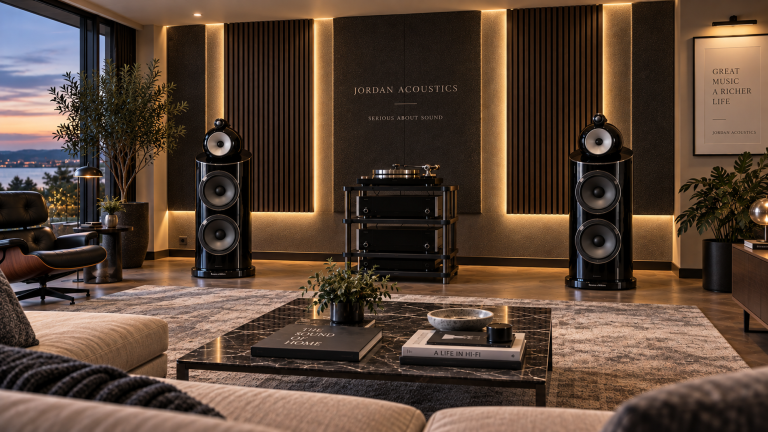

































One of the questions we’re asked surprisingly often is: how much do I actually need to spend to get a genuinely good hi-fi system?
The simple answer is that there isn’t a fixed figure.
A well-matched £10,000 system can sound considerably better than a poorly chosen system costing twice as much. Equally, spending more absolutely can bring meaningful improvements, but only when the individual components work properly together and are suited to the room they’re being used in.
The key is not simply how much you spend, but where you spend it.
Start with the system, not the individual products
It’s very easy to approach hi-fi by looking for the “best” amplifier, the “best” speakers or the “best” streamer within a particular budget.
In practice, that isn’t how the best systems are put together.
Every component has its own character, strengths and requirements. A fantastic amplifier paired with unsuitable speakers can produce disappointing results, while more modest components that complement each other can sound remarkably convincing.
Speaker sensitivity, amplifier power, room size, listening distance and even the type of music you listen to all play a part.
This is why system matching matters so much.
Around £5,000
At this level, it’s possible to put together a genuinely enjoyable system with very few compromises.
A good integrated amplifier, quality bookshelf or compact floorstanding speakers and a capable streaming source can deliver excellent results.
Rather than trying to spread the budget across too many separate boxes, we would normally concentrate on getting the core components right.
A simple, well-chosen system will nearly always outperform a more complicated one built purely around specifications.
Around £10,000
Once you reach this level, there is considerably more freedom.
You can start looking at better loudspeakers, more substantial amplification and higher quality source components without one part of the system becoming an obvious weak link.
Improvements tend to come in areas such as scale, control, refinement and soundstage.
Bass becomes more authoritative, vocals sound more natural and the system becomes better at separating instruments without making the presentation feel clinical.
For many listeners, this is where hi-fi starts to become genuinely difficult to walk away from.
Around £20,000
At this point, careful system matching becomes even more important.
The performance potential is significantly higher, but so is the possibility of getting the balance wrong.
Loudspeakers will often account for a significant proportion of the budget, although they still need amplification capable of controlling them properly.
Source quality also becomes increasingly important.
A better DAC, streamer, turntable or phono stage can reveal substantially more information, but only if the rest of the system is capable of showing the difference.
This is also where installation, positioning and the listening room begin to have an even greater influence on the final result.
£50,000 and beyond
Reference-level systems are less about chasing specifications and more about removing limitations.
The improvements can be surprisingly subtle in isolation but very significant when heard together.
There is often a greater sense of ease, scale and realism. Music becomes less obviously reproduced and more believable.
Better systems also tend to perform well at lower volumes, retaining dynamics and detail without needing to be played loudly.
At this level, every part of the system matters.
Amplification, loudspeakers, sources, supports, mains, cabling, setup and the room itself all become part of the equation.
Simply buying the most expensive components available is rarely the answer.
Should you spend more on speakers or amplification?
There is no universal rule.
Traditionally, people were often advised to spend the largest part of their budget on loudspeakers. While there is some logic to this, modern systems are far too varied for a fixed percentage to make much sense.
Some loudspeakers are relatively easy to drive and will work extremely well with modest amplification.
Others require considerably more current and control before they start performing properly.
It’s therefore better to think about the amplifier and speakers as a partnership rather than two separate purchases.
The same applies to the source.
There is little point putting an exceptional digital source into a system that cannot reveal what it is doing, just as there is little point buying extremely revealing loudspeakers and driving them with an amplifier that struggles to control them.
Don’t forget the room
Your listening room is effectively another component in the system as we covered in a previous article.
A pair of loudspeakers that sounds superb in one room may behave very differently in another.
Large areas of glass, hard flooring and minimal furnishings can make a system sound brighter and more reflective, while heavily furnished rooms can sometimes absorb too much energy.
Speaker size is also important.
Bigger is not automatically better.
A smaller loudspeaker working comfortably within a room can often produce a more natural and controlled result than a much larger design that overwhelms the space.
Pre-owned equipment can change the equation
Buying pre-owned or ex-display equipment can be an excellent way of increasing the performance available within a fixed budget.
High-end audio products are generally built to last, and carefully selected used equipment can offer exceptional value.
It can sometimes allow a customer with a £30,000 budget to put together a system that would have cost considerably more when new.
Take this ex-demo Gryphon Diablo 333 and these ex-display B&W 803 D4’s for example:
As always, condition, history and suitability are more important than simply finding the biggest discount.
So how much should you spend?
Spend enough to achieve the level of performance you genuinely want, but don’t assume that spending more automatically guarantees a better result.
A properly chosen £10,000 system can be outstanding.
A carefully assembled £20,000 or £50,000 system can take things considerably further.
But at every level, the same principle applies: the system needs to work as a whole.
Good hi-fi isn’t about collecting expensive components.
It’s about finding the right combination of equipment for your room, your music and the way you listen.
At Jordan Acoustics, that has always been the starting point.
If you’d like to book some time to discuss your next system or upgrade please call us on 01202 911886 or book your slot through the website.